 English


Itching is a subjective sensation that indicates the skin is being irritated. It naturally triggers the urge to scratch, which is the body’s way of trying to remove or relieve the source of irritation on the skin. However, when itching becomes persistent and difficult to tolerate, it can significantly affect a person’s quality of life.
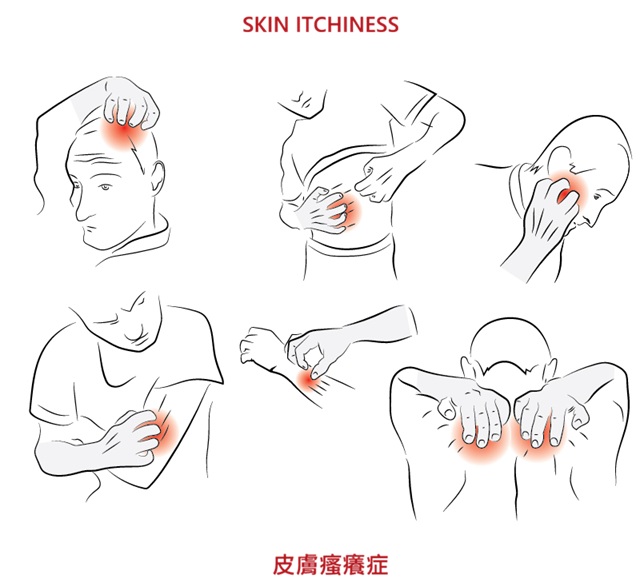
Itchy symptoms
Frequent scratching may lead to various skin problems, including redness and inflammation, scratch marks, blood crusts (scabs), eczema-like skin changes, and secondary infections.
The skin is the body’s largest organ, covering about 1.5 to 2 square metres. Itching can occur anywhere on the body and can be caused by many factors, ranging from minor irritation to serious underlying diseases.
Before seeing a doctor, it is helpful to remember details about when the itching started, where it occurs, and how it has changed. This information can assist the doctor in making an accurate diagnosis. Whether the itching affects the whole body or only a specific area is an important clue, as different types of itching may require different treatment approaches.
The causes of localized itching are sometimes the same as those of generalized itching. For example, people with diabetes may experience itching over the entire body or only in specific areas. However, in many cases, localized itching is closely related to irritation or disease affecting the particular area involved. For example:
- Anal itching is often associated with intestinal parasites, hemorrhoids, or anal fissures.
- Scrotal itching may be related to excessive sweating, friction, or fungal infections such as jock itch.
- Vulvar itching (itching of the external female genital area) is commonly associated with vaginal discharge, vaginitis, or cervicitis.
If the cause of localized itching can be identified and properly treated, the symptoms can often be effectively relieved. Therefore, localized itching is generally easier to diagnose and manage than generalized itching that affects the whole body. This section discusses several common forms of localized itching and the methods used in Traditional Chinese Medicine (TCM) to relieve itching.

TCM lung is responsible for disturbing nutrient essence to the skin and hair, and also disseminates the protective qi.
From a TCM holistic view, skin conditions are closely linked to internal organs and meridians. Lungs rule the skin; they regulate the dissemination of nutrient essence to the skin and body hair, so as to keep them moist and glossy. Protective qi of the lungs flows over the skin to guard against invasion by external irritations; it also regulates sweating and provides warmth for the body. When these particular functions are weakened, the skin will become dysfunction.
In addition, TCM views the skin and internal organs as being connected through the meridian system. When a particular meridian or organ becomes diseased, corresponding changes may appear in the related area of the skin, such as alterations in color, texture, or sensation. Conversely, when the skin is affected by pathogenic factors, the disorder may spread along the meridians and influence the body’s internal systems. TCM physicians observe the appearance of the skin and evaluate accompanying symptoms to assess the condition of the organs, qi, blood, and meridians. Based on this assessment, they formulate an appropriate treatment plan following the principle of syndrome differentiation, selecting therapies and herbal medicines that address both the symptoms and the underlying imbalance. In other words, when treating itchy skin disorders, TCM physicians focus not only on the local skin problem but also on its underlying internal causes. By taking a holistic approach and treating the body as an integrated whole, TCM aims to achieve more effective and lasting therapeutic results.
Generally, localized itching is often viewed as the result of both internal and external factors. Internally, an underlying imbalance in the body may make the skin more susceptible to irritation and itchiness. Externally, factors such as unhealthy lifestyle habits, environmental influences, friction, allergens, or other local irritants can trigger or aggravate symptoms. Therefore, TCM treatment aims not only to restore the body’s internal balance but also to identify and remove external or local causes of irritation, helping to relieve itching and prevent its recurrence.

Skin segments according to the order and arrangement of meridian flow.
Further Readings:
Holistic concept Six evils Organs Meridian system Diagnostic principles Herbal application

