 English

In Western medicine, doctors typically look for specific causes of disease and treat the affected organs or body systems. Traditional Chinese Medicine (TCM), however, takes a more holistic approach, viewing the body as an interconnected whole. As a result, Western medicine and TCM differ significantly in their principles, diagnostic methods, and treatment approaches.

Ancient Chinese people believed that human life was closely connected to the universe. In their view, humans occupied a central position between Heaven above and Earth below. Observations of the natural world were used to explain the laws governing life, and correspondences were established between the cosmos and the human body. For example, the skin was associated with the surface of the Earth, the five internal organs were linked to the Five Elements (Wood, Fire, Earth, Metal, and Water), and the eyes and ears were related to the Sun and Moon in Heaven.
According to this worldview, the universe is a unified and harmonious whole. Nothing exists in isolation; every being and phenomenon can only be understood in relation to its surrounding environment. This way of thinking became a fundamental feature of Taoist philosophy and profoundly influenced the development of Traditional Chinese Medicine (TCM).
TCM is based on the belief that all things in the universe are interconnected and constantly interact with one another. Human beings are regarded as an integral part of this larger whole and must therefore be understood in relation to their internal and external environments.
The holistic concept is one of the fundamental characteristics of TCM and is reflected throughout its theories of physiology, pathology, diagnosis, and treatment. It emphasizes viewing the body as an integrated whole while also recognizing its dynamic relationship with the external world. Thus, the holistic concept in TCM encompasses both the unity of the human body and its close interaction with nature and the surrounding environment.
The body’s organs and systems are interconnected and function as an integrated, balanced whole.
TCM regards the body as an integrated whole, with all organs and body systems closely interconnected. They work together to maintain normal function, and an imbalance in one area can affect the rest of the body. According to TCM theory, these relationships are centered on the five zang organs and linked through the meridian network.
The five organ systems of the body
| Paired organs | Dominated body tissues | Openings on the head | Outer manifested regions | |
| Heart | Small intestine | Blood vessels | Tongue | Face |
| Liver | Gall bladder | Tendons | Eyes | Nails |
| Spleen | Stomach | Muscles (limbs) | Mouth | Lips |
| Lung | Large intestine | Skin | Nose | Body hair |
| Kidney | Bladder | Bones (bone marrow) | Ears | Head hair |
Furthermore, qi (vital energy), blood and body fluids are the material basis for various body functions; they flow through the body to facilitate all parts of the body working together and to ensure the unity and harmony inside the body.

The relationships of five organ systems according to the five element theory
Physiological aspect: Through the network of meridians, the five zang organs, six fu organs, body tissues, sensory organs, bodily openings, and the limbs are interconnected, forming five major functional systems that are closely linked and work in harmony. The body’s vital activities are coordinated through the interaction of essence (jing), qi (vital energy), and spirit (shen), enabling the body to function as a unified and balanced organism.
Each organ not only performs its own individual functions; it also complements other organs and even the entire internal system to perform life activities. For example, although nutrient essence is transformed in the spleen, but the transforming process also involves nourishment of the heart blood, regulation of the liver and promotion of the kidney. A harmonious and coordinated relationship between the organs is essential for normal life activities.

Illustration of organs in Chinese medicine
Pathological aspect: Attention is paid to the interrelation and interaction between localized pathology and the whole body, TCM holistic approach always associates localized pathology with overall body reactions. Physicians not only concern about local pathology and its corresponding internal organ, they also consider the influence on unaffected body parts, so as to predict the disease progression. The clinical manifestations of disease are a result of the overall body reactions. For example, in case of damp-heat irritating the liver and gall bladder, not only these two organs are affected, it may also affect the spleen, stomach, heart and kidney, leading to nausea, no appetite, diarrhea, insomnia, lumbar soreness, knee weakness and fatigue. In case of liver blood deficiency, there may be symptoms like blurred vision (openings of the liver), dizziness, pale nails (outer manifested region of the liver), muscle or tendon spasms (dominated tissues of the liver), limb weakness, scanty menses and even missed periods (the Conception Vessel and Thoroughfare Vessel are controlled by the liver). Disorders of internal organs, qi, blood and body fluids can be manifested on the superficial body, while a localized or regional pathology can affect the whole body and cause extensive dysfunctions.

Reflections of tongue surface according to Chinese medicine
Diagnostic aspect: The Four Diagnostic Skills and correlations made between internal and external body are concrete samples of TCM holistic concept. Since the organs and tissues of the body are interdependent physiologically and mutually affected pathologically, physicians are able to assess the status of internal organs and construct a detailed picture of the patient’s disease based on the symptoms, pulse and tongue signs of the patient, laboratory tests or other modern diagnostic technologies are rarely used. For example, the tongue has special relationships with the internal organs. The tongue body and its coating create the tongue signs, which are an important factor in diagnosis. Changes in the tongue signs reflect changes of organ functioning, blood and qi activities, body fluid metabolism, and progressing direction of diseases. In addition, it is a routine practice of TCM to associate a patient’s condition with external influences and personal details. Factors like weather, season, lifestyles, eating habit, mental state, body constitution, age, gender and career are usually taken into account in TCM diagnosis, they help provide a full evaluation and design the most appropriate treatment plan to the patient.
Therapeutic aspect: TCM treatment focuses on the overall disharmony of the body rather than specific organ or body region. Most of the time, remedies are designed to restore the balance of the whole body, and are through comprehensive therapeutic effects to achieve the healing propose. A disharmony pattern is the general conclusion of the cause, pathological changes, developmental stage and overall body reactions to a particular disease. Treatment based on syndrome differentiation (identifying disharmony pattern) implies the holistic concept of TCM, which has made use of the organic wholeness and interrelationships of the body. When there is an organ disorder, physicians may not target on one organ only and even not treat the affected organ, they can achieve a healing result by treating other seemingly irrelevant organs. For example, stomach problems can be solved by treating both stomach and spleen; respiratory problems may be treated by both spleen and stomach instead of treating the lungs. More remarkably, for many localized or superficial conditions, physicians will treat the corresponding internal organs and even the entire body is treated. For example:
| Symptoms and signs | TCM diagnosis | Treatment plan |
| Red eyes | Excessive fire in the Liver | Clear liver fire |
| Painful and swollen gum | Kidney deficiency | Warm up the Kidney |
| Toe necrosis | Blood stasis of the meridians | Activate blood and warm up meridians |
| Persistent ulcers and abscesses | Blood and qi deficiency | Replenishing blood and qi |
| Runny nose and common cold | Wind-cold invading the Lung | Disseminating lung qi and relieving cough |
| Hair loss and declined hearing | Exhaustion of kidney essence | Replenish essence and invigorate the Kidney |
The body should remain in harmony with the external environment.
The body communicates with the external environment constantly, factors such as weather, geographic location, working and family environments can all affect our health. External changes cause the body to respond physiologically or pathologically, which reflects the united relationship between human and the outside world. We should live in harmony with nature, other people, and the immediate environment. When changes occur in external environment, and the body fails to adapt to the changes, diseases are likely to occur.
Climatic Influences: Under normal circumstances, climatic factors do not cause disease, only in extreme changes or when the body is too weak to adapt to climatic changes, they became pathogens that could cause disease. The six climatic influences, which are wind, cold, summer-heat, dampness, dryness, and fire or heat, are considered as the importance external pathogens for disease development, also known as the “six evils” in TCM. The correlations made between the climate and disease development is a particular way for TCM to explore the imbalance of the body. It facilitates physicians to identify the exogenous pathogens based on particular symptoms, regardless of identifying bacteria, viruses, toxins or parasites, and allows for a different approach in disease treatment that has been met with success over the centuries in China. For example, in common cold that has symptoms such as headaches, fever and sticky throat secretions, physicians may diagnose as wind-heat invading the lungs, using herbs such as honeysuckle flower and forsythia capsule can clear the symptoms.
Seasonal Influences: The body makes appropriate physiological responses in accordance with seasonal changes. For example, it opens the skin pores and sweat more in summer, while closes the skin pores and sweats less in winter, thus the body temperatures can be maintained within a normal range. Moreover, the body pulse tends to be taut in spring, surging in summer, floating in autumn, and deep in winter, which reflect the body’s blood and qi activities also correspond to the natural world. TCM physicians always consider the seasonal physiological changes when distinguishing the abnormal body signs from the normal ones.
The pathogenic features of the six TCM evils
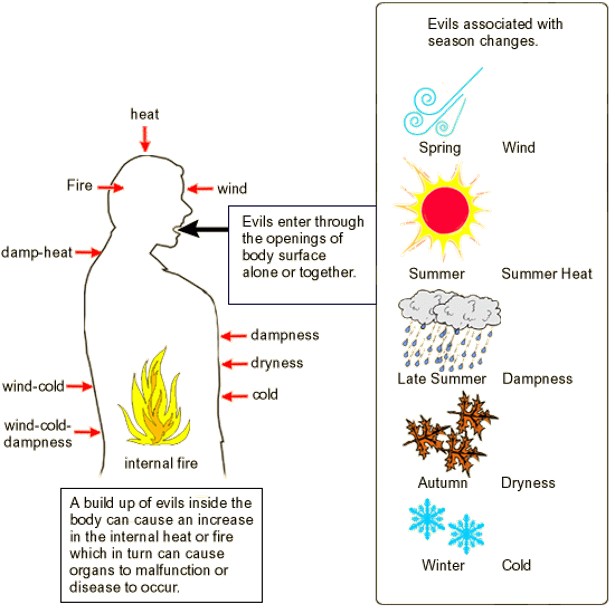
The pathogenic features of the six TCM evils
Seasonal influences are important inducing factors for many diseases too, for example, respiratory infections and nose bleeding are common in spring, heat strokes and digestive problems are common in summer, malaria and dysentery tend to occur in autumn; arthritis and respiratory problems tend to relapse in winter.
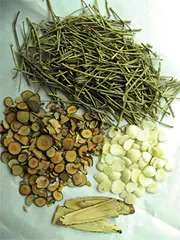
Ephedra Decoction is a common prescription for common cold.
For TCM physicians, seasonal influences on the body are important considerations when making diagnosis, selecting therapies and even suggesting preventive measures. For example, elder people who suffer from chronic cough or panting are likely to feel better in spring and summer, but feel worse in autumn and winter. Their conditions are usually due to weakened spleen and kidney, and warming herbs are indicated, physicians will suggest them to take preventive measures in hot summer, so that in winter, their conditions are less likely to relapse, or the symptoms can be less severe and in shorter duration. In other cases, people with blood deficiency and hyperactive liver are likely to experience dizziness, distending headache, blurred vision, ear ringing and mental fatigue in spring. Winter is the season where the body conserves energy and builds strength as a prelude to spring. TCM will advise the patients eating more nourishing and tonic foods in winter for prevention.
Geographic influences: People in different geographic regions live with different lifestyles, customs and cultures, thus they develop particular body constitutions and susceptible to particular health problems. In Northwestern highlands of China, people tend to have a stronger constitution. When they are sick, their body is likely to be cold outside but heat inside, thus dispersing external coldness and clearing internal heat are often necessary in the treatment. In Southeastern coastal regions of China, people tend to have a weaker constitution, and are particularly susceptible to skin problems and seasonal infections. Physician often consider the geographic and dietary influences on the patient’s body when giving a treatment. TCM herbal applications often reflect the geographic differences, take common cold as a sample, in the frigid zone of Northwest China, a larger dosage of potent warming herbs such as ephedra and cassia twig are often used, while in the temperate zone of Southeast China, mild warming herbs such as schizonepeta herb and ledebouriella root are used and the dosage is relative smaller.
Social and life influences: Technology and social progress has created many new health problems, stress is a part of modern life. We are constantly overwhelmed by demands at work and home, and challenged by social turmoil, life changes, financial and interpersonal issues. A combination of these factors puts extra strain on our mind and spirit, and also drains the body’s reserves. Health is achieved only when the body is in balance which includes the physical, emotional and mental aspects. Overreacting psychological activities can easily disturb the organ functioning, as time passes some real physical damage will occur. The psychological damage to internal organs and resulting psychosomatic ailments (i.e. insomnia, stomach upset) are of primary concern by TCM physicians.
TCM has a unique concept about mind and body connection, stress and mental distress are considered to be the usual factors that affect disease development. Excess psychological factors are known as the “seven emotions” which include joy, anger, sadness, anxiety, worry, fear and fright. Each of the emotions interacts with particular internal organs and affects qi activities differently, leading to different disharmony patterns. Clinically, patients with mental problems such as depression, insomnia and anxiety often respond to TCM treatment, which may be combined with conventional medication or used alone under proper supervision of physicians.
From the above, we can see that TCM holistic approaches are based on the views of whole-body, whole-person, whole-world. Under the guidance of holistic concept, all aspects must be considered when treating a problem, only a comprehensive analysis on the patients’ physical condition, age, lifestyles, medical history, career and mental state can a correct diagnosis be made and then treated properly.
References:
- Beijing University of TCM (edited), Basic Theories of Traditional Chinese Medicine, Academy Press, 1998.
- Li Qizhong (edited & complied), Elaboration of TCM Basic Theories, Publishing House of Shanghai Traditional Chinese Medicine University, 2006.
- Qin Bowei (compiled), Elementary Chinese Medicine, People’s Medical Publishing House, 2006.
- Fang Yaozhong (compiled), Plain Speeches on TCM Basic Theories, People’s Medical Publishing House, 2007.
- Cai Jianying (edited & complied), Summaries on Ancient and Modern Philosophical Concepts of TCM, Chinese Medicine Science and Technology Publishing House, 2005.
Compiled:
Rose Tse, Integrated Chinese Medicine Holdings Ltd.

