 English
Itchy skin is a common complaint that can be both frustrating and distressing. Persistent itching not only harms the skin but can also disrupt sleep and interfere with everyday life. TCM provides a variety of itch-relieving therapies, among which acupoint stimulation is widely used. By stimulating specific acupoints, some people may experience quick, and sometimes immediate, relief from itching.
According to TCM theory, the meridian system connects the body’s interior and exterior, linking the internal organs, tissues, and skin into an integrated network. Skin disorders are often considered outward manifestations of underlying imbalances in the organs, qi, blood, and meridians. For example, lesions around the eyes may be related to the Liver meridian, those affecting the nose to the Lung meridian, ear disorders to the Kidney meridian, mouth ulcers to the Spleen meridian, and tongue ulcers to the Heart meridian. By examining the location of skin lesions and tracing the pathways of the meridians, TCM practitioners can gain insight into the affected organs and meridians, with particular attention to the site where the condition first appeared.
 Spleen Meridian |
 Large Intestine meridian |
The amount of qi and blood flowing through each meridian is believed to influence the severity and prognosis of skin diseases. Conditions occurring along meridians rich in both qi and blood, such as the Stomach and Large Intestine meridians, are generally considered more responsive to treatment. In contrast, disorders affecting meridians with abundant qi but relatively less blood, such as the Triple Burner (Sanjiao) and Gallbladder meridians, may be slower to heal and more prone to recurrence. Skin diseases involving Yang meridians tend to respond more readily to treatment, whereas those affecting Yin meridians are often more chronic and persistent. These principles help TCM practitioners assess the likely course of a skin condition and guide treatment strategies.
It is a routine for TCM physician to consider the above factors during clinical evaluation and designing treatment for skin problems.
Acupuncture and Moxibustion Therapies to Stop Itchy Skin
Acupuncture and moxibustion regulate the meridians, improve blood and qi flowing of the skin, and thus help easy itchy conditions. There are plenty of evidences that acupuncture and moxibustion can inhibit inflammatory reactions and calm down the activities of nerve endings. For anti-itch purpose, physicians mainly stimulate body points along the spleen and large intestine meridians, which aim to clear heat, cool blood, nourish yin, enrich blood, eliminate wind and stop itching. Below are some acupuncture protocols for skin itching:
-
Acupuncture protocol (I)
Selected points: qu chi (Li 11), he gu (Li 4), xue hai (Sp 10), ge shu (Bl 17), wei zhong (Bl 40), tian jing (Sj 10); apply with reduction techniques.
Method: after the needles are inserted, twirl or rotate for a while and then retain for 15~30 minutes. Apply one or two times daily during acute attacks; apply once every two days in chronic cases. For some women, if their itching is associated with menstrual periods, they should start acupuncture therapy 3~5 days before the period comes.
Analysis: itchy skin is mainly associated with wind pathogens attacking the superficial body, qu chi and he gu belong to the large intestine meridian, stimulating them can smooth circulation and clear pathogens on the skin; xue hai is specialized in treating blood diseases, when it works with the qu chi and he gu, the resulted therapeutic effects are dispersing wind and cooling blood; wei zhong is a cleft point of blood, and ge shu is an influential point of blood, the two are specially for treating skin problems that deeply involved the blood aspect; tian jing is the sea point of the triple burner meridian, stimulating it can facilitate circulation in the meridian and promote the skin to expel the accumulated heat. For clinical applications, some assistant points will be added to fit for individual conditions. For example, itching associated with menstrual periods, additional points like guan yuan shu (Bl 26), gan shu (Bl 18), shen shu (Bl 23) will be stimulated to regulate the Thoroughfare Vessel and Conception Vessel, in order to resolve menstrual related problems.
-
Acupuncture protocol (II)
Major points: qu chi (Li 11), he gu (Li 4), xue hai (Sp 10), zu san li (St 36), ge shu(Bl 17), feng men (Bl 12), fei shu (Bl 13).
In case if the itching in mostly on the trunk and upper limbs, add assistant points like shen men (Ht 7), wai guan (Sj 5),gan shu (Bl 18); if the itching is mostly on lower limbs, add assisitant points likewei zhong (Bl 40), cheng shan (Bl 57), yin ling quan (Sp 9), san yin jiao (Sp 6).
Method: after the needles are inserted, twirl and rotate for a while to create a medium level stimulation. It is best to achieve an obvious needling sensation spreading outwards to the surrounding area. Each time, retain the needles for 20~30 minutes. Apply daily or every two days, 10 sessions are as one course of treatment.

Acupuncture points for skin itching

Acupuncture points for skin itching
Auricular Therapy to Stop Itchy Skin
Auricular stimulation is one of the popular Chinese methods. It involves stimulating points on the ears that correspond to different organ systems of the body, in order to achieve general or local effects. The way to stimulate the ear points can be needling, sticking seed patches, blood-letting, or moxa heating. Auricular therapy is often used along with other treatment methods to enhance the overall efficacy and speed recovery. Below is a protocol for skin itching.
Selected points: shen men (1), lung (2), occipital (3), endocrine (4) and adrenal gland (5), see the graphic below for locations.
Methods: Select three to four points on one side, and place on the seed patches. Press for 4~8 times every day, and each time last for about 5 minutes. Change the patches to alternative side every three days.
For acute itchiness, it may be suitable to apply blood-letting method. Rub the back of an ear with alcohol cotton ball to clean and sterilize the area, prick on a vein quickly and squeeze gently to release 4~5 drops of blood, then press the punctured point with a clean swab to stop bleeding. This can be done every two days, prick on alternative side each time, 10 times are as one course of treatment.
Those who have bleeding problem, anemia, hypotension or pregnant women are NOT recommended.
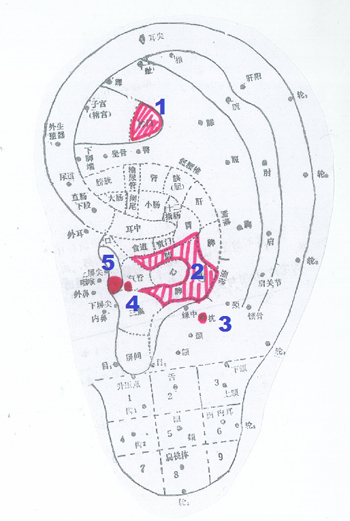
1. shen men 2. Lung 3. occipital 4. Endocrine 5. Adrenal gland
Navel Therapy to Stop Itchy Skin
The navel, also called shen que (Cv 8), is an important therapeutic body point in TCM. Navel dressing is a popular therapy for activating qi flow and promoting internal balance. Physicians usually prescribe an herbal mixture for patients to do it at home. Below are the anti-itch prescriptions for the dressing mixture.
- Ledebouriella root (15g), caltrop fruit (15g), common cnidium fruit (15g), belvedere fruit (15g), dictamnus root bark (15g) and peppermint (10g); grind into fine powder and store in a container. This is suitable for generalized itchiness in particular associated with chronic hives.
- Chinese safflower, arnebia root, gardenia fruit and Chinese rhubarb root, equal amount for each; grind into fine powder and mix with borneol (10g), store in a container and put aside.
- Chinese safflower, peach kernel, bitter apricot seed and gardenia fruit, for 100g each; grind into fine powder and mix with borneol (10g), store in a container and put aside.
- Angelica root, white peony root and rehmannia root, for 30g each; dwarf lily-turf tuber, Chinese senega and unprocessed fleeceflower root, for 20g each; sopora root, belvedere fruit, dictamnus root bark, and Sichuan Chinaberry, for 15g each; scorpion and centipede for 10g each; pan roast all the ingredients to dehydrate, and then grind into powder mixture, store in a container and put aside.
Every night, take 10g of the mixture, mix it with a few drops of vinegar or Vaseline and paste on the navel, cover by gauze or tape to fix in place for 12 hours, and then wash away in the morning. In winter season, moxa warming is applied on it additionally for 10 minutes to enhance the effect.
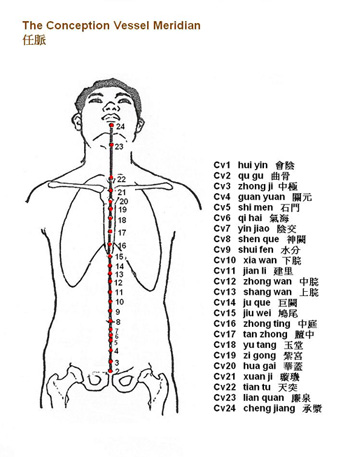
The Conception Vessel Meridian
Further Readings:
Holistic concept Meridian system Organ systems Blood Qi (vital energy) Yin yang meridians Acupuncture techniques Regulating effects of acupuncture

